
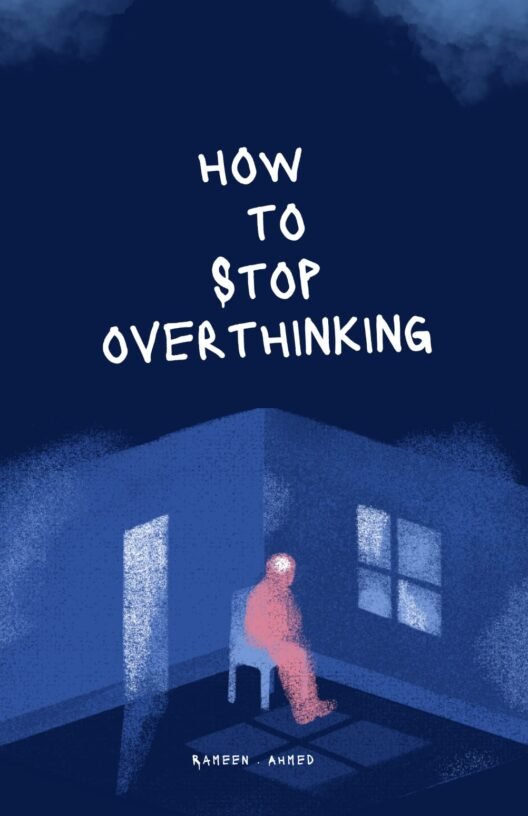
How To Stop Overthinking
Written By Rameen Ahmed…
The Silent Burden of Overthinking
“We don’t overthink because we think too much; we overthink because we feel too deeply.”
Introduction :
Overthinking has become a widespread psychological challenge, particularly among the younger generation, especially Gen Z. It is no longer a rare experience but a quiet struggle that affects countless individuals. Rather than being a temporary phase, overthinking is often a persistent and exhausting mental state. It is a battle that takes place within the mind one that many people silently endure.
The Nature of Overthinking :
The human mind is incredibly powerful, yet it can easily turn against itself. A single thought can expand into countless possibilities, doubts, and fears. What begins as a simple idea often develops into a complex web of uncertainties. These thoughts grow deeper and heavier over time, eventually affecting a person’s emotional and mental stability.
Even the smallest interactions can become sources of distress. A casual remark may linger in the mind, replaying again and again, each time with a new interpretation. In such situations, the harm does not come from others but from our own perceptions. Overthinking, therefore, is not just thinking excessively it is a state where thoughts begin to control and confine the mind.
Impact on Mind and Body
Overthinking does not only affect mental peace; it also has physical consequences. The mind and body are closely connected, and when the mind is disturbed, the body responds. Continuous stress can lead to fatigue, headaches, poor sleep, and anxiety. Over time, this mental strain can weaken overall well being, making a person feel emotionally and physically drained.
Why Do We Overthink?
Contrary to common belief, the brain is not a slave to thoughts. Instead, it is shaped by past experiences and emotions. When something stressful or painful occurs, the brain attempts to protect us by analysing it repeatedly. It believes that by revisiting the situation, it can find a solution.
However, this process often has the opposite effect. Instead of clarity, it creates confusion and stress. The mind becomes trapped in a loop, searching for answers that may not exist.
Managing Overthinking :
Although it is impossible to completely stop thoughts, it is possible to manage them. One effective approach is to remind yourself that not every thought represents reality. Creating this mental distance can reduce the intensity of negative thinking.
Practices such as deep breathing can calm the mind and body. Staying engaged in productive activities helps prevent unnecessary thoughts from taking over. Reducing isolation and limiting excessive mobile use can also support mental clarity.
Journaling is another powerful tool. Writing down thoughts allows emotions to be expressed and understood more clearly. Additionally, speaking with someone you trust can provide relief and new perspectives. Sharing feelings often reduces their intensity.
An Important habit to develop is questioning your thoughts. Not every thought is true; many are simply fears. Asking yourself, “Is this real, or is this my fear?” can help break the cycle of overthinking.
A Personal Reflection :
There are moments when the mind refuses to be quiet, when even silence feels overwhelming. In such times, it is easy to believe that something is wrong. However, the reality is different. The mind is often trying too hard to protect us in ways that are no longer helpful.
Overthinking is not a weakness; it reflects emotional depth and sensitivity. The goal is not to silence the mind completely but to guide it towards rest and balance.
Conclusion :
Peace does not come from controlling every thought. Instead, it comes from allowing thoughts to pass without attaching meaning to each one. When we stop treating every thought as a problem to solve, we begin to experience mental calmness.
Overthinking may be a powerful force, but it does not have to control us. With awareness, patience, and practice, it is possible to regain control and find inner peace.
“The mind is a beautiful servant, but a dangerous “